
Why Lithium batteries “won’t charge” after a BMS cutout and how to reset them
If a technician tells you a lithium battery is "dead" and won't take a charge at all, the battery is often fine. What's actually happened is the Battery Management System (BMS) has cut it off, and a standard charger has no way to get past that.
This is one of the most common lithium faults workshops run into, and it catches out anyone used to lead-acid diagnostics. With a conventional battery, low voltage means low charge. With lithium, low voltage can mean the BMS has deliberately disconnected the cells to protect them, and no amount of charge current reaches the battery until that protection is released.
What the BMS is actually doing
Every LiFePO4 battery has a BMS managing the individual cells, and its main job is stopping the pack being damaged by over-discharge, over-charge, or cell imbalance. When cell voltage drops below the BMS's low-voltage threshold, it opens the internal contactor and disconnects the battery from its terminals. That's a safety feature, not a fault. The problem is what happens next. A standard charger connects, sees no voltage response, and has no way to talk to the BMS or close the contactor again. The battery just sits there looking dead, and workshops without the right equipment end up replacing batteries that are actually fine.
Why a standard charger can't fix this
A normal charger, even a good multi-stage one, is built to push current into a battery that's already accepting it. It can't tell the difference between an open contactor and damaged cells, it has no way to apply the low-current signal that brings the BMS back online, and it has no safe way to reintroduce charge once the contactor does close. This is a lithium-specific problem that needs lithium-specific equipment.
How contactor reset actually works
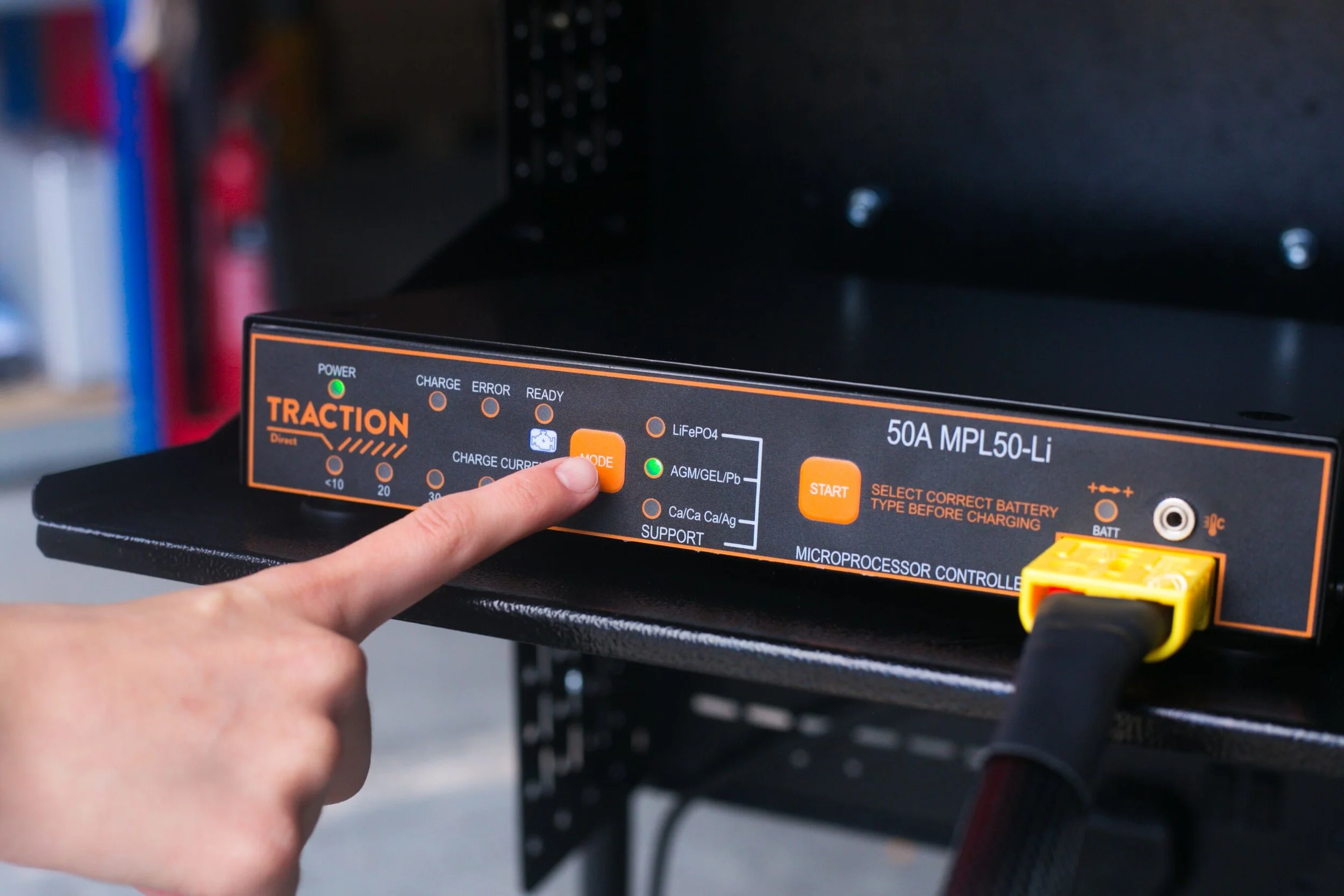
Chargers built with proper LiFePO4 support, including our MPL50-Li, include a contactor reset function for exactly this scenario. Instead of assuming the battery will respond normally, the charger applies a carefully controlled signal that prompts the BMS to re-close the contactor and reconnect the cells. Once that happens, the battery charges properly on a profile matched to LiFePO4 chemistry, 13.6V in the MPL50-Li's case. Its low starting voltage also means it can pick up packs that have dropped well below where most standard chargers give up.
Getting this wrong costs time and money either way: write off a recoverable battery, or force charge it with the wrong equipment and risk damaging the pack permanently.
Equipment built for the job
The MPL50-Li is a full battery maintainer built with this exact problem in mind. It selects between LiFePO4, AGM/GEL and flooded lead-acid profiles, includes contactor reset, and runs Supply Mode at up to 50A @ 13.4V for diagnostic and ECU work where you need stable voltage rather than a charge cycle.
If lithium-fitted vehicles are becoming a bigger share of what comes through your door, a charger that can recover a BMS-locked battery not just charge one that's already working is what separates a quick fix from an unnecessary replacement.
-
It's unlikely to damage the battery, since the BMS simply won't accept the charge, but repeatedly force-connecting a standard charger to a non-responsive pack is bad practice. Use a charger with a proper LiFePO4 contactor reset function instead.
-
A BMS cutout shows zero voltage at the terminals with no response from a standard tester, which looks identical to a dead battery from the outside. The only way to tell them apart is to attempt a contactor reset with lithium-specific equipment. If the contactor closes and voltage returns, it was a cutout, not a failure.
-
Description No. "Lithium-compatible" just means the charger uses the right voltage profile for LiFePO4. Contactor reset is a separate, specific function. Check the charger explicitly lists it, rather than assuming lithium compatibility includes it.